The reflection
Central pool
On the main axis
Book the sunrise dayGuides
Language
Currency
Check open spotsstarting at $5 · free cancellationYour stop on the map
Answer in brief
The best Taj Mahal sunrise reflection is shot along the central pool and garden canal on the main axis, with the Great Gate as a frame.
Rules for the camera
See 9 route stops
Start by picking a route; tap a pin or stop for its note and Google Maps.
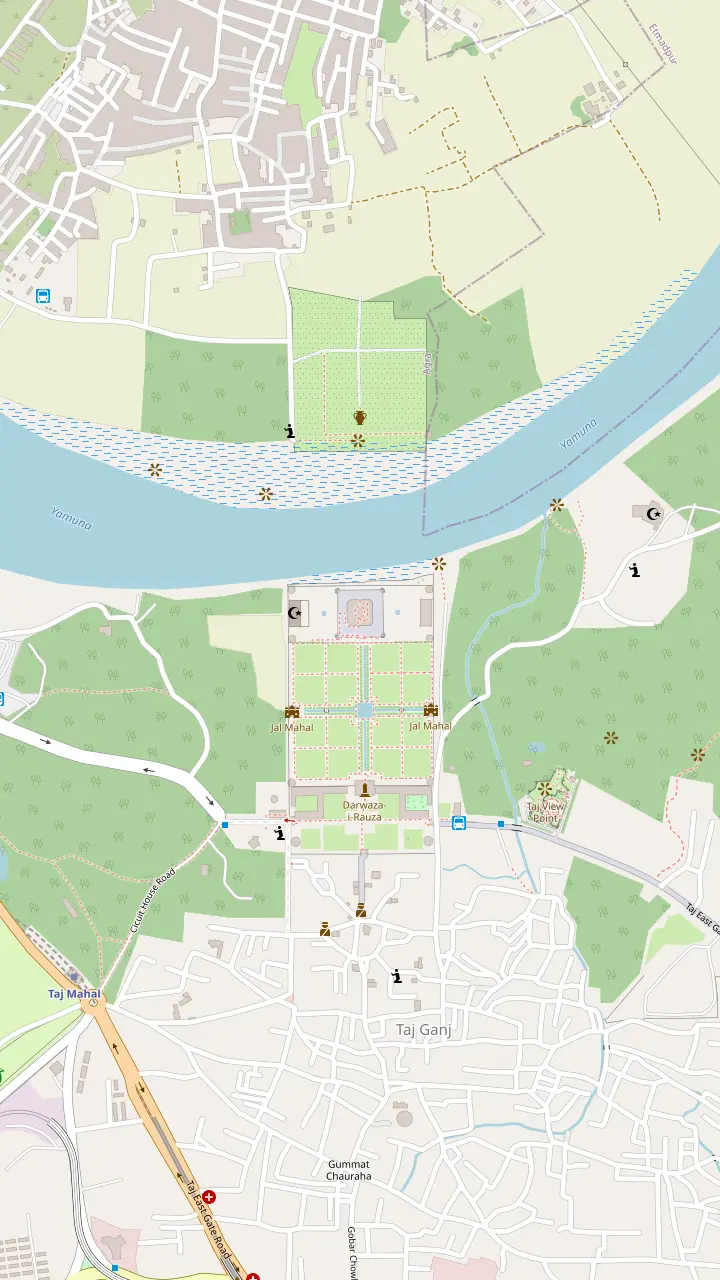
The western gate is the main entrance, and its ticket windows open one hour before sunrise.
Google MapsThe official page says to prefer the eastern gate to avoid crowds, and its ticket windows open one hour before sunrise too.
Google MapsThe southern gate is exit-only at present.
Google MapsThe tomb stands at the northern end of the complex, beyond the greenery and fountains.
Google MapsThe Agra Development Authority built a viewing point on the Yamuna bank near Mehtab Bagh, and it shows the Taj Mahal on Fridays as well.
Google Maps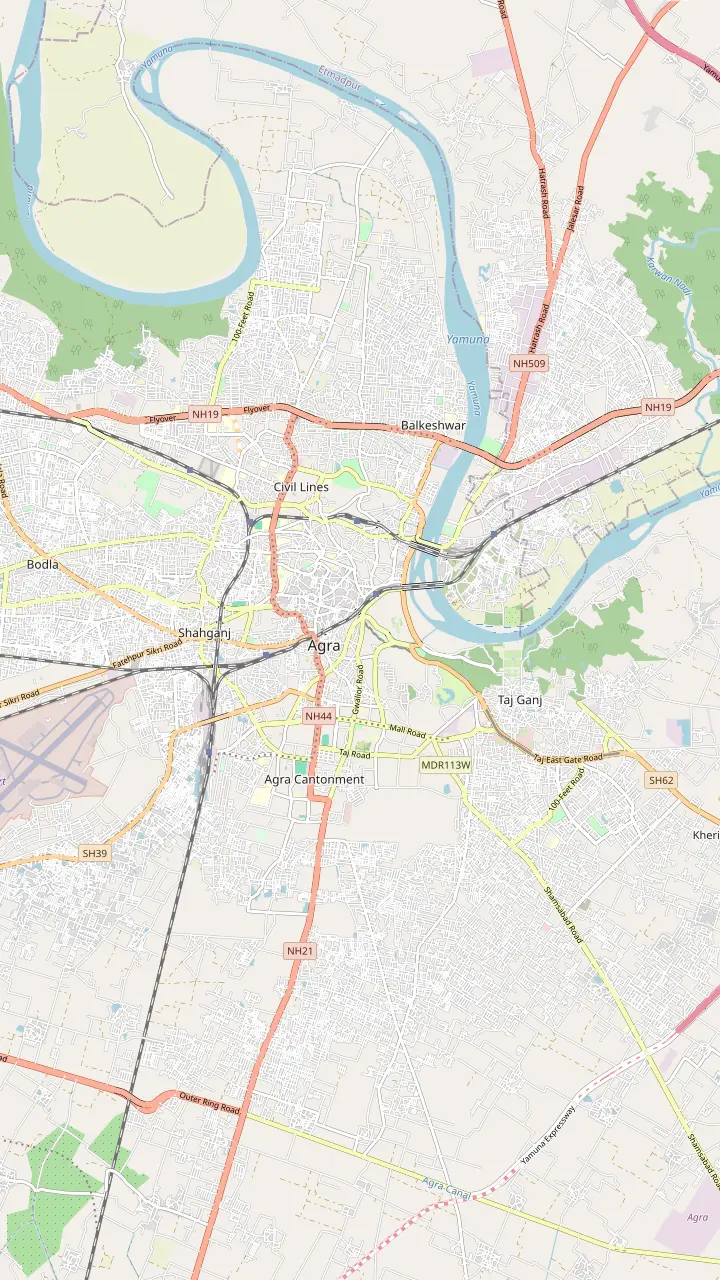
The complex spans 17 hectares of gardens and pathways.
Google MapsAgra Fort is open from sunrise to sunset every day.
Google MapsItimad-ud-Daulah's Tomb, called the Baby Taj, was the first Mughal structure built entirely of marble.
Google MapsAgra Cantonment is the main railway station of the city.
Google MapsMap © OpenStreetMap contributors
The famous picture is made in a few places along one axis, and a few more across the river. Here is where to stand at dawn, what the light does and which rules shape your kit.
Editorial team, tajmahalsunrisetour.quest · Updated November 7, 2026 · Quick read: 8 min
Key facts
The picture most people want is the Taj Mahal reflected in water, and the monument's own layout explains where to find it. The Uttar Pradesh tourism department says a raised white marble platform at the crossing of the garden walkways carries an ornamental pool with five fountains, and that the main north-south axis runs through the garden canal, with the mausoleum, the pool and the Great Gate set along it.1,2 The Taj Mahal sunrise reflection you have seen in photographs is shot along that line.
Early helps for a plain reason: still water. A reflection needs a calm surface, and the first hour of the day is when the air is quietest, before wind, crowds and the day's movement ruffle it. Stand low, near the water's edge, and keep the tomb centred, since the garden is laid out symmetrically around its axis. The official pages describe the pool and the canal but make no promise about the state of the water on a given morning, so treat the reflection as a good chance, not a certainty.
Allow yourself time to wait. The light changes by the minute at dawn, and a reflection that is flat and grey at one moment can be pink and gold a little later. Take several frames as the colour builds rather than one at the first glow. If the central pool is crowded, which it usually is once the gates have been open for a while, step a few paces back along the canal and use the long perspective instead.
| Position | What you get | Best for |
|---|---|---|
| Central pool | An ornamental pool with five fountains1 | The reflection shot |
| Down the axis | The tomb at the northern end of the garden3 | The front view |
| Great Gate | A red sandstone frame with inlaid marble4 | A framed first sight |
| River viewpoint | Golden light at dawn and dusk17 | A Friday or a calm frame |
| Agra Fort balcony | The Yamuna and the Taj from the pavilions13 | A distant view |
| Yamuna boat | Photo opportunities from the river18 | A low angle |
Positions come from the tourism department's descriptions and top views list; the map shows where each one stands.19
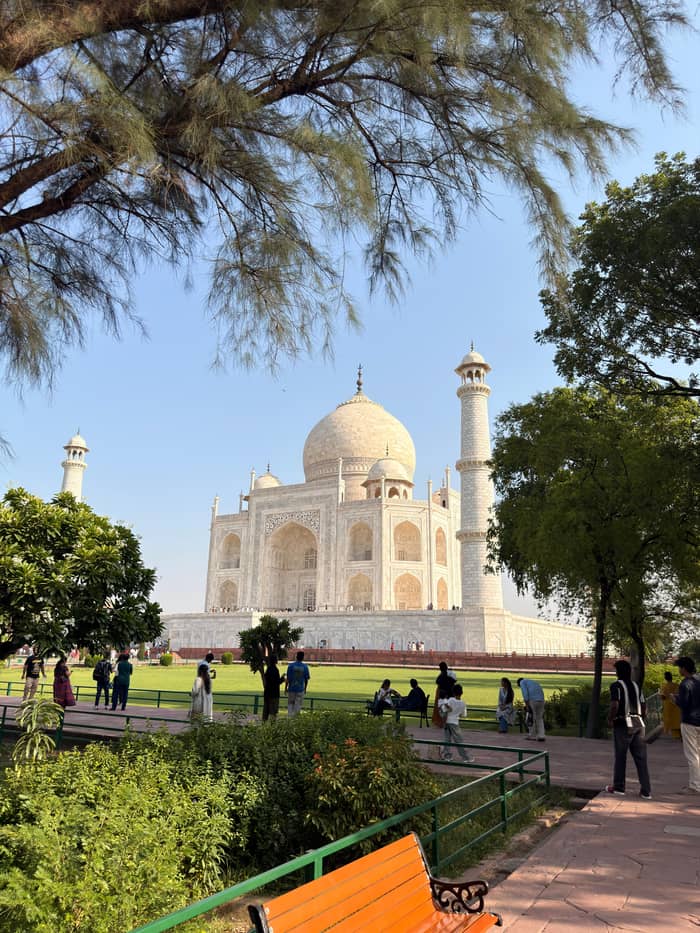
The Taj Mahal front view at sunrise is the classic composition, and the official plan of the complex dictates it. The tourism department says the tomb is at the northern end with an expanse of greenery and fountains between it and the gateways, and that the main axis carries the mausoleum, the pool, the great gate and the forecourt.3,2 That straight line is why a photograph from the entrance looks so balanced.
The Great Gate is the natural frame. The department says the main gateway is built in red sandstone, with calligraphy and flower and vine motifs of semi-precious stones inlaid in white marble.4 Stand under the arch and the white tomb appears at the far end of a dark frame, which is the first sight most visitors remember. Shoot it from slightly to one side as well, so the gate does not trap you into one angle, and keep a steady grip in the low light.
Choose your gate with the shot in mind. The department says the west gate is the main entrance, facing the Shahjahan garden, Agra cantonment and Agra city, while the east gate faces the Taj Nature Walk and Fatehabad town and is the one to prefer to avoid the crowd.14,15 Either way, walk straight through the gateway before you stop, because the view opens only once you are through. The low sun comes from your right as you face the tomb, which lights its east side first.
The tourism department says the Taj attracts 7 to 8 million visitors a year, more than 0.8 million from overseas.16
The Taj Mahal at sunrise with mist is a look the tourism department itself describes. It calls the Taj most alluring in the relative quiet of early morning, shrouded in mists and bathed in a soft red glow.5 Mist softens the edges and makes the minarets fade, which is wonderful when it is thin and frustrating when it is thick. A morning with a light haze and an open sky gives you the pastel version that photographs well.
Colour is the other variable. The department says the Taj looks milky white in the soft light of early morning, glistens bright and dazzling in the afternoon sun, and appears golden when the moon shines.21 A second page says it is pinkish in the morning and milky white in the evening, with shades in between across the hours and the seasons.22 That is the range to expect at dawn: a pink flush that gives way within minutes to cool white.
Exposure follows the light. Expose for the sky, not the marble, in the opening minutes, and let the white tomb sit slightly under, because it brightens fast. Shoot a few frames at different times rather than waiting for one perfect minute, and bring a cloth for the lens in a damp morning. The department adds that sunrise is preferred for its pink twilight and that early morning avoids both heat and crowds, which makes it the best hour for a clean frame.10
If I want the classic reflection
Stand at the central pool early
The department places an ornamental pool with five fountains at the garden's centre.1
If I want mist and a soft glow
Aim for the first hour
The department calls early morning the Taj at its most alluring, shrouded in mists.5
If I want a calmer frame
Try the river side
The river viewpoint is open from sunrise, and the Taj can be seen from it.6
If I am here on a Friday
Shoot from across the river
If I want to use a tripod
Arrange ASI permission first
Tripods need permission from the Archaeological Survey of India.8
The reflection
On the main axis
Book the sunrise day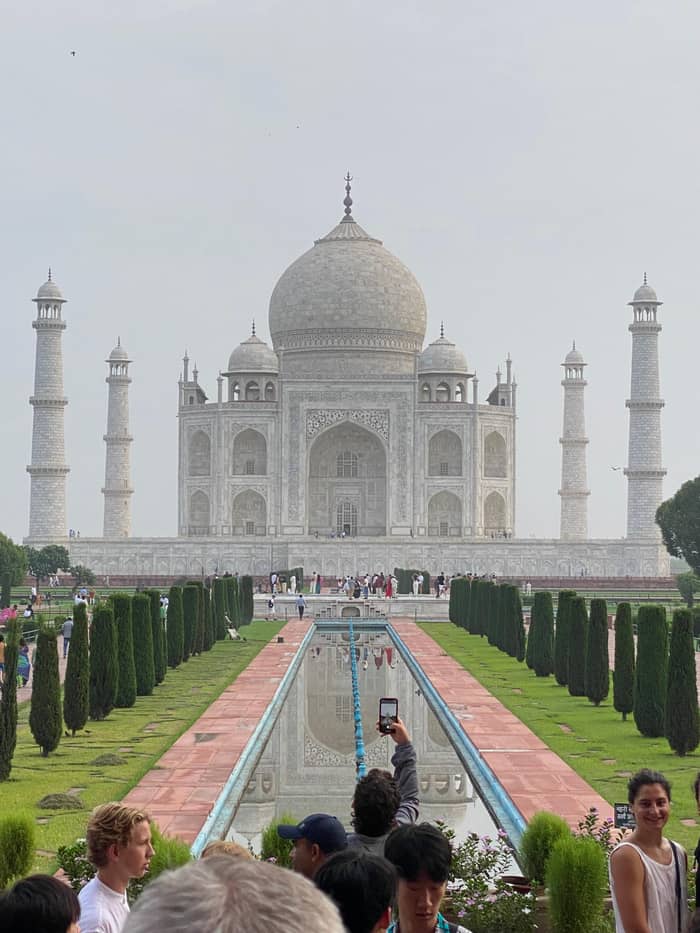
The first sight
Under the arch
Book the sunrise day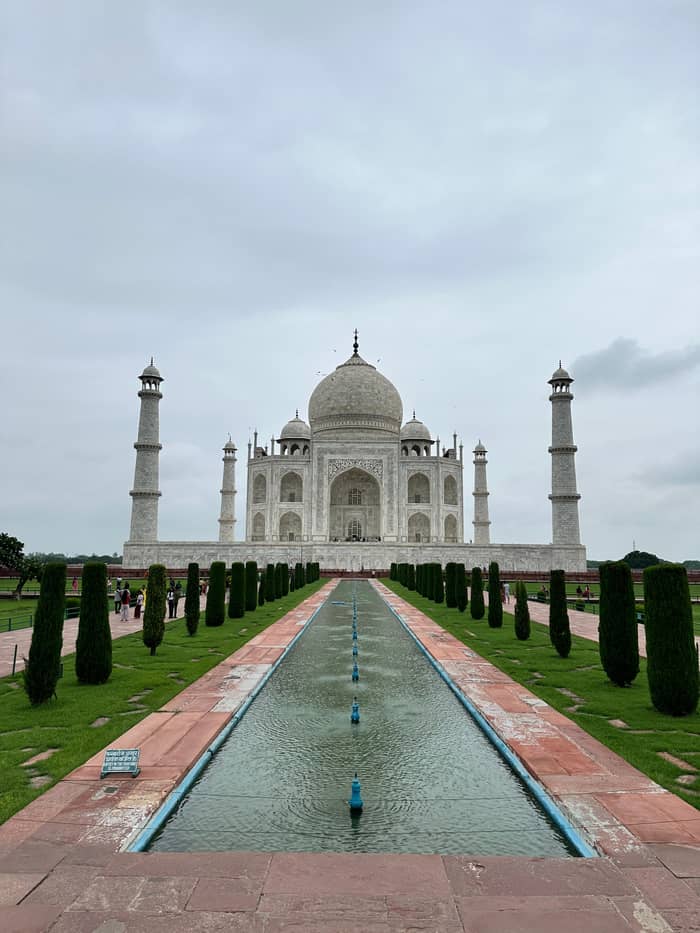
Open on Fridays
Across the Yamuna
Book the sunrise dayThe tourism department publishes its own list of top views of the Taj Mahal. The list starts with the view from inside the Taj grounds, from Mehtab Bagh and from Agra Fort, and goes on to a view from a hotel room, a 360 degree view, the view at night, the view from the Yamuna river and the view from the top of the dome.19,36 It is a useful reminder that the monument can be photographed well from places other than the central pool.
Several of those views suit a dawn start. Agra Fort's pavilion balconies give views of the Yamuna River and the Taj Mahal, the department says, which makes it a fine second stop on a morning that begins with the monument.13 Incredible India adds that boat rides on the Yamuna River offer photo opportunities of the Taj Mahal, a different angle from the water for travellers with time and a taste for something less crowded.18
Each position trades something. The grounds give the symmetrical postcard but the most people. The fort gives distance and a sense of the river's scale. The water gives an unusual low view. A hotel with a rooftop gives you a view without leaving the building, which suits a very early alarm. Pick one main position and one backup, so a hazy morning in one place can be rescued in another.
Gate opens
The grounds open 30 minutes before sunrise.9
First light
The pink twilight is why most tourists choose sunrise.10
Mist and glow
The Taj is shrouded in mists with a soft red glow.5
Sun clears
Cameras are allowed; the mausoleum interior is not for photos.11,7
10.00 AM
The museum inside the complex opens, with free entry.12
Later
Agra Fort's balconies and the river viewpoint stay open.13,6
The Agra Development Authority built a viewpoint on the Yamuna bank near Mehtab Bagh, and the tourism department says it gives a panoramic view of the Taj Mahal from sunrise to midnight: golden in the morning and evening, milky white in the afternoon and lit by moonlight at night.17 It is open every day, including Fridays, which makes it the dawn alternative when the grounds are shut.6
The view from there is of the river face of the monument, with the water in the foreground. The department's description of the terrace says its full splendour is displayed towards the river, where it forms an uninterrupted red sandstone band 28 feet 6 inches high and 984 feet long.37 That band is exactly what you see from across the water, and it gives the picture a base that the front view does not have.
Entry is charged. The viewpoint's tickets are listed at Rs 50 for Indians and Rs 200 for foreigners from sunrise to sunset, and Rs 200 and Rs 500 from sunset to midnight.38 The garden at Mehtab Bagh, which sits beside it, is listed separately in the monuments table.39 Our page on Mehtab Bagh and the Yamuna covers both places in detail, with the rules and the best light for the river side.
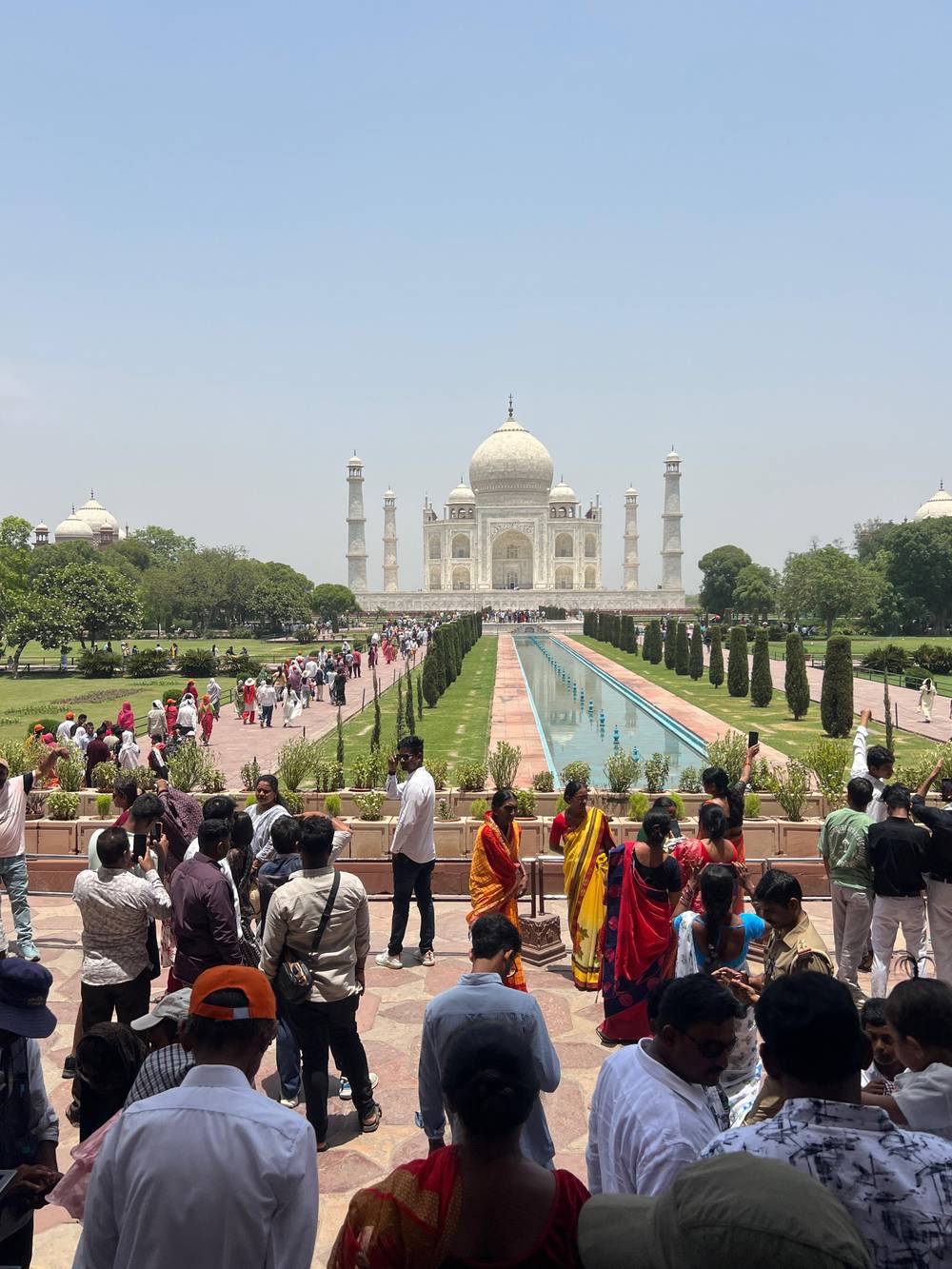
Christopher Lau on YouTube · Video data is requested only when you tap play.
the Taj is at its most alluring in the relative quiet of early morning, shrouded in mists and bathed with a soft red glow.
A few rules decide what you can shoot. The tourism department says photography is prohibited inside the main mausoleum, so the interior stays unphotographed, and it asks visitors to avoid touching and scratching the walls and surfaces of the monument.7,40 Everything outside the mausoleum, from the gateway to the platform and the garden, is open to photography, which is where the famous pictures are made.
Equipment has limits too. Tripods are not allowed without permission issued by the Archaeological Survey of India, and a drone camera is strictly prohibited inside and around the Taj Mahal.8,35 A camera is fine, since the list of barred electric goods makes an exception for one.11 If you need a tripod for a serious project, ask the survey well before you travel, and do not expect to talk your way through at the gate.
If you want help, the department advises hiring approved guides and photographers who show their identity cards.41 A good guide knows where the crowds gather and where the light falls, which is why a guided sunrise visit is popular with photographers. Our listing's private guide leads the Taj Mahal visit at sunrise, so the camera and the history come together on one early morning. Check any photographer's card before you pay.
Start at the gate rather than the garden. The grounds open 30 minutes before sunrise, so you can be inside while the sky is still blue and the marble is cool grey.9 Walk straight through the Great Gate, pause for the first frame under the arch, and then head for the axis. Resist stopping at the first souvenir seller or photographer who offers to pose you; the light is the scarce thing at this hour.
Work the pool and the front view while the colour builds, then move to the sides of the garden for angles with trees and the minarets. When the sun has cleared the horizon and the pink has faded, switch to details: the inlay on the gate, the dome, the marble platform. The department gives the outer dome as 44.4 metres high and the inner as 24.35 metres, so a wide lens or a step back is needed to fit it.42 Keep a record of the time of each good frame.
Finish with a second angle. The Taj Museum inside the complex opens from 10.00 AM to 5.00 PM, and Agra Fort and the river viewpoint are both open later in the day.12,43 If your day continues on a private tour, the listing runs Agra Fort and the Baby Taj after the Taj Mahal, which gives different light and a calmer set of pictures. You will leave with a full card and a sense that you have seen the monument in more than one mood.
FAQ
The department places an ornamental pool with five fountains at the crossing of the garden walkways.1
The department describes early morning as shrouded in mists with a soft red glow.5
The department says photography is prohibited inside the main mausoleum.7
Tripods are not allowed without permission issued by the Archaeological Survey of India.8
A drone camera is strictly prohibited inside and around the Taj Mahal.35
Sources
Planning the Taj Mahal at dawn? A real person answers here.