Daytime
Day entry
By visitor type
Book a guided dayGuides
Language
Currency
Check open spotsstarting at $5 · free cancellationChecklist to tick off
Private sunrise day trip to the Taj Mahal from Delhi
★ 4.9 · 2,276 reviews total
Answer in brief
Visiting the Taj Mahal costs Rs 1100 for a foreign visitor, Rs 540 for SAARC and BIMSTEC citizens and Rs 50 for Indian citizens, with an optional Rs 200 extra for the main mausoleum.
Discounts and extras
7-item checklist
Check things off as you go; your progress is kept on this device.
0 / 7 ready
All ticked. Only the booking is left: your sunrise at the Taj Mahal.
Book a spotThe Taj Mahal has tiered entry prices, an optional extra for the main mausoleum and a short list of rules at the gate. Here is what each ticket costs and how to buy it.
Editorial team, tajmahalsunrisetour.quest · Updated November 7, 2026 · Quick read: 9 min
Key facts
The Taj Mahal has tiered entry prices, set by who you are and not by when you arrive. The Uttar Pradesh tourism department lists a foreign tourist at Rs 1100, a citizen of a SAARC or BIMSTEC country at Rs 540, and a domestic visitor, Indian citizen or OCI cardholder at Rs 50, each with an optional extra Rs 200 for the main mausoleum.1,2,3 Those are the headline figures for anyone asking how much it costs to visit the Taj Mahal.
The gap between the tiers is large, and the pages do not explain it, so we will not guess at a reason. What matters for a traveller is to find the line that applies to your passport or card and to read the extra Rs 200 as a separate decision.1 The extra is optional, which means you can walk the garden and the platform on the basic ticket and still see the monument from every outside angle, so the choice is about the interior alone, not about whether the visit is worth making.
All amounts are in rupees, exactly as the department states them, and we do not convert them. Prices on official pages change from time to time, so check the current table before you travel; the page we use is the department's visiting-hours and ticketing page. A foreign visitor on a private tour usually pays the fee in advance through the operator, but the official table is the place to confirm what a given ticket should cost.
| Visitor type | Entry | Mausoleum extra | Golf cart |
|---|---|---|---|
| Foreign tourist | Rs 11001 | Rs 200, optional1 | Included19 |
| SAARC or BIMSTEC citizen | Rs 5402 | Rs 200, optional2 | Included19 |
| Indian citizen or OCI | Rs 503 | Rs 200, optional3 | Rs 2519 |
| Child below 15 | No entry fee4 | Not stated | Not stated |
Rupees as the tourism department lists them, with online tickets cheaper by Rs 5 per Indian ticket and Rs 50 per foreigner ticket.5
Can you tour inside the Taj Mahal? Yes, but the inside is a separate ticket. The tourism department says visiting the main mausoleum needs an additional ticket of Rs 200 along with the regular ticket, and the same fee appears beside each entry price.12,1 Without it you can still walk the grounds, the garden and the terrace around the platform. The extra buys one thing, the interior, and everything else is already on the basic ticket.
What you see inside is quiet and dim after the glare of the platform. The department asks visitors not to make noise inside the mausoleum, and says photography is prohibited there, so this is a part of the visit to experience rather than to photograph.14,15 It also asks visitors not to touch or scratch the walls and surfaces, which are heritage sites that need special care.16 Shoe racks are available just below the main mausoleum free of cost.17
Foreign visitors get a small convenience. Shoe covers, a half-litre water bottle, a guide map, the battery bus and the golf cart service come free with the foreigner entry ticket and with the SAARC and BIMSTEC tickets, the department says.18 That makes the inside visit a smoother one than it sounds. If you are short on time, the extra ticket is the one to buy first, because the mausoleum is the part of the visit that cannot be seen from anywhere else.
There are two routes. The tourism department says day tickets can be bought either from the ticket windows at both gates or online, and that the Archaeological Survey of India's ticketing sites offer e-tickets to foreign and domestic visitors for the Taj Mahal and other monuments.23,6 The windows are at the east and west gates, where sales run from one hour before sunrise until 45 minutes before sunset.10,11
Online is the cheaper route, and usually the faster one. The department says tickets bought online carry a discount of Rs 5 per Indian ticket and Rs 50 per foreigner ticket.5 The pages we read list one set of day fees and do not mention a separate ticket for Taj Mahal sunrise tickets, so a dawn visit uses the ordinary day ticket and the same gates, which open 30 minutes before the sun.24
A ticket still has to be shown at the gate, and every visitor is asked to carry an identity proof issued by the authorities.9 There are separate queues for foreign and domestic tourists, with signs to direct each group.8 If you buy at the window, join the queue early on a busy morning. If you buy online, keep the ticket on your phone, because a flat battery at the gate is a bad start to a day that began at dawn.
If I am a foreign visitor
Budget Rs 1100 and the extra
The department lists Rs 1100, with Rs 200 more for the main mausoleum.1
If I hold an Indian or OCI card
Rs 50, plus the extra
Domestic, Indian and OCI visitors pay Rs 50, with Rs 200 for the mausoleum.3
If I travel with a child under 15
The child enters free
The department says children below 15 pay no entry fee.4
If I want to skip the ticket window
Buy an e-ticket online
The ASI sites sell e-tickets, with a discount for online buyers.6,5
If I want a guide inside
Hire an approved guide
The department advises approved guides who show their identity cards.22
Daytime
By visitor type
Book a guided day
Optional extra
Added to the entry fee
Book a guided day
Booked ahead
On moon nights only
Book a guided dayA ticket is not only a pass through the gate. The tourism department lists several services that come with it, starting with the water bottle, which is allowed inside the monument, and the shoe covers, the guide map and the battery bus that foreign tickets include.18 A wheelchair for differently abled people and a first aid box are available at the ASI office at the Taj Mahal, the same page adds, so access is better than the long walk suggests.18
The ride from the parking area is part of the cost. Battery buses and golf carts run from parking to the gate, and the golf cart fee is included in the ticket price for foreigners and for citizens of SAARC and BIMSTEC countries, while Indian citizens pay Rs 25 per person.7,19 Remember that no polluting vehicles are allowed within 500 metres of the Taj Mahal, so the last stretch is always by battery bus, cart or on foot.26
Inside the grounds, the Taj Museum opens from 10.00 AM to 5.00 PM and entry is free.27 It follows its own hours rather than the gate's, so a dawn visit usually finishes before it opens. If you want it, plan a second hour in the late morning, or a return after breakfast, and treat the free museum as the bonus that fills the gap between a sunrise start and the heat of the day, when the open marble is at its hottest.
Days ahead
E-tickets are sold on the ASI sites with a discount for online buyers.6,5
At the parking area
Battery buses and golf carts run from parking to the gate.7
At the gate
Foreign and domestic queues are separate, and an ID is required.8,9
At the window
Inside
The main mausoleum needs the additional Rs 200 ticket.12
On the way out
The south gate is open for exit only.13
A guide is the one cost the ticket never includes. The tourism department advises tourists to hire approved guides and photographers who show their identity cards, and says visitors can email or call the UP Tourism office in Agra to find a government approved guide.22,28 We do not quote guide fees, because no official page we read gives one, and a made-up number would be worse than none.
A guided day trip folds the cost of a guide into one booking. Our listing is a private day trip by air-conditioned car from Delhi, with a private guide who speaks Chinese, English, French, German, Japanese, Russian, Spanish, Hindi or Italian, and stops at the Taj Mahal, Agra Fort and the Baby Taj. The listing gives its duration as 6 to 12 hours and offers free cancellation up to 24 hours before for a full refund.
Whether to book a tour or buy the ticket yourself depends on how you travel. If you are comfortable arriving in Agra by train and hiring a guide at the gate, the ticket is the only thing you need. If you want a driver, a guide and a fixed plan from Delhi, a day tour removes the logistics. The listing tells you what is included for the option you pick, so read it before booking and keep the rupee fees in mind as a separate line, because the operator's price covers the transport and the guide, and what the monuments charge is worked out on top.
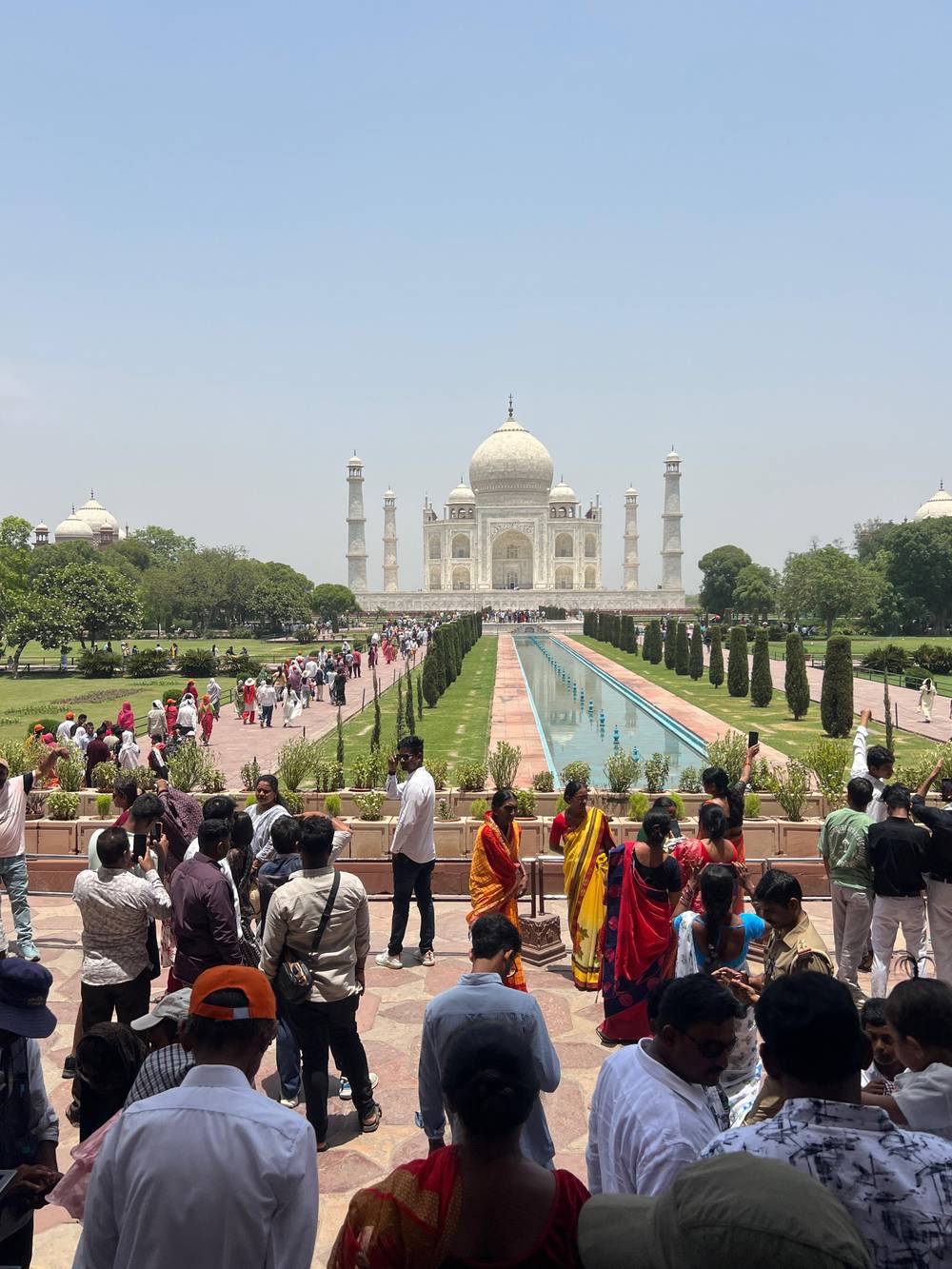
Nomadic_dolphin on YouTube · Video data is requested only when you tap play.
Both foreign and domestic visitors may use the e-ticket booking for the ASI Taj Mahal and other monuments.
A Taj morning usually grows into a day, and the department's fee table prices the neighbours too. Agra Fort costs a foreign visitor Rs 650 on weekdays and Rs 600 on a Friday or after a Taj visit, while an Indian visitor pays Rs 50 on weekdays and Rs 40 on Fridays.29 The tomb known as the Baby Taj, Itimad-Ud-Daulah, is listed at Rs 30 for Indians and Rs 310 for foreigners on weekdays.30
Across the river, the garden at Mehtab Bagh is listed at Rs 25 for Indians and Rs 300 for foreigners in the same table.31 The Agra Development Authority's separate viewpoint near it charges Rs 50 for Indians and Rs 200 for foreigners from sunrise to sunset, and Rs 200 and Rs 500 from sunset to midnight.32 They are easy to confuse, so check which one you are standing in front of. A glance at the sign at the entrance tells you which ticket office you have reached.
Night viewing has its own price. The department gives it as Rs 510 for a domestic tourist and Rs 750 per person for a foreigner.20 The slots are booked ahead on the ASI payment site, seven days before the date, so that fee is not one you meet at the window.21 None of these amounts are quoted in dollars here, because a conversion would be out of date within days. Rupee prices are also what you will see at the ticket windows, which makes them easier to check against your receipt.
Entry at the Taj Mahal is a security procedure as much as a ticket check. The department asks visitors to avoid big bags and books, because they may increase the security check time, and it lists items that are prohibited inside, among them tripods, drones, food, tobacco and knives.33,34 Drones are strictly prohibited inside and around the monument, and tripods need permission issued by the Archaeological Survey of India.35,36 The page on what to bring has the full checklist.
Behaviour inside the complex is also covered. Mobile phones are to be kept switched off or on silent, and tourists are advised to stay inside the monument as directed on the ticket or by ASI staff.37,25 The south gate is closed to entry and allows exit only, so plan your route out as well as in.13 None of this is hard, but it explains why queues move faster for visitors who arrive prepared.
If you need to leave a bag, the department says the east gate has a cloak room beside its ticket window and the west gate has one at the shopping complex.38 Use that rather than carrying a large bag through the queue. A small day bag, a ticket, a photo ID and a bottle of water is the lightest kit that still gets you through. The rest can wait at the gate or in the car, with the driver, until you return.
FAQ
The department says there is no entry fee for children below 15, domestic or foreign.4
The fee is included for foreigners and SAARC and BIMSTEC citizens; Indian citizens pay Rs 25 per person.19
The east gate has one by the ticket window and the west gate has one at the shopping complex.38
Sources
Planning the Taj Mahal at dawn? A real person answers here.